

In warehouse lighting, the brightness, uniformity and color temperature of the light are all very important factors. The correct warehouse lighting solution can improve work efficiency, protect the safety and health of employees, and reduce the cost of repairing and replacing lamps. Here are some possible warehouse lighting options.
First of all, LED lighting is the best choice for LED high bay warehouse lights. LED lights have the advantages of long life, high efficiency, and easy installation and maintenance. LED lighting fixtures are generally more durable than traditional lighting fixtures, can reducing the cost of repair and replacement fixtures.
Secondly, the lighting in the warehouse must ensure sufficient brightness. To achieve this, high-brightness LED lights should be selected.
Third, the lighting in the warehouse should be uniform. This avoids shadows and light leaks in the work area. To achieve uniform lighting, LED high bay warehouse lights can be arranged with a reasonable layout to avoid strong light sources in the warehouse.
Fourth, the appropriate color temperature should be selected. Cooler lighting can improve visual acuity but can make employees uncomfortable. In contrast, warmer lighting can create a cozy and welcoming atmosphere but may reduce employee productivity. It is recommended to choose lighting between warm and cool tones to ensure a balance between employee comfort and work efficiency. Of course, specific lighting needs must be adjusted according to the lighting space and requirements.

1. How to choose led high bay warehouse lights according to the application?
① Warehouse height affects the selection of LED high-bay warehouse lights.
Most warehouses have ceiling heights between 15ft and 25ft. When choosing suitable LED high bay warehouse lights, lighting fixtures with higher brightness and longer lifespan should be selected. LED lights are the preferred choice, with luminous efficiency exceeding 100 lumens per watt, and can even reach 180 lumens per watt. Even when installed at high heights, they can still provide sufficient brightness and have a long service life.
When selecting LED high bay warehouse lights, high bay lights with an output of 150 lm/w should be chosen to ensure that the lighting fixtures do not reduce illumination due to height, preventing dark corners in the warehouse.
② Warehouse size and the number of LED high bay warehouse lights
Selecting the appropriate number of LED high bay warehouse lights, first measure the size of the warehouse. The size of the warehouse affects the number of LED high bay warehouse lights, and having too few or too many lights can result in unsatisfactory lighting effects.
③ Consider energy saving and consumption reduction. The energy-saving characteristics of LED are its unique advantages. LED lights have a longer service life, which will greatly save energy expenses in the long run. 100W LED lamps can replace traditional 400W HID lights, and mention sensor also available.
④ Consider the life time of led high bay warehouse lights fixture.
Choosing lights with a long service life is the most economical and environmentally friendly option. As is well known, traditional high-intensity discharge (HID) lamps have a lifespan of only six months, while JCLGL LED high bay warehouse lights use LED lighting, with a service life of up to 50,000 hours and a 5-year warranty. This is more environmentally friendly and energy-saving.
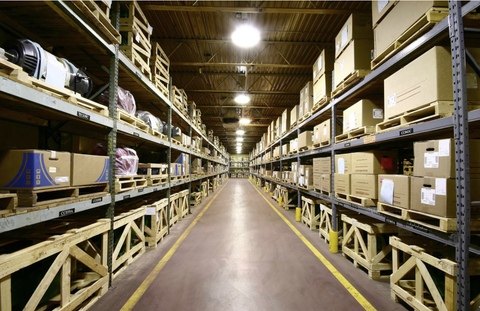
2.How Many Warehouse Fixtures Needed For Space?
If you are unsure about how many lights should be installed at a certain height, you can use the LED High Bay Warehouse Lighting Calculator designed by JC-LGL. Simply enter your space dimensions, select the desired fixtures, and specify their primary use to get specific reference values for the number of lights needed.
3. What issues should be considered when choosing LED high bay warehouse lights?
① The installation height of the lamp. For warehouses with higher heights, the installation height needs to meet the requirements and cannot be too low or too high to ensure the radiation range and brightness of the LED high bay warehouse lights. Too low will produce too much glare, and too high the brightness may not be enough.
② Lamp density. Considering the overall lighting effect of the warehouse, the density of LED high bay warehouse lights should be well controlled, which will be more conducive to improving the lighting quality.
③. Light intensity and color temperature. The display effects and optimal usage intensity of lighting fixtures in different places are different. For lamps in different places, you should choose to use lamps whose color temperature changes with environmental changes. The most common color temperature for warehouse is 5000K, color temperature 2700K-6500K is optional.
④ Waterproof level of lamps
Due to the complex working environment of warehouses, which is prone to contamination from moisture, dust, and other factors, the waterproof rating of the lighting fixtures is also crucial. It is recommended to choose lighting fixtures with a protection rating of IP65 to ensure their service life and performance. The JCLGL LED high bay warehouse lights has a waterproof rating of IP65, making it suitable for warehouse environments and capable of withstanding water jet impact.
4. LED High Bay Warehouse lighting Standards
The distance between fixed lights in the warehouse and the goods should be no less than 50 cm.
The distance between fixed lights and goods in the warehouse, referred to as the light distance, should not be less than 50 cm to prevent the lights from being too close to the goods and causing fires due to the heat generated by the lights. In order to reduce the occurrence of accidents, insiders pay attention to the "five distances" in the warehouse, which are ceiling distance, lamp distance, wall distance, column distance, and stack distance.
Column distance: refers to the distance between the cargo pile and the roof column, usually 10-20 cm. The function of the column spacing is to prevent moisture emitted by the columns from affecting the goods, and to protect the column feet to avoid damage to the building.
Stacking distance: refers to the distance between cargo piles, usually 100 cm. The function of the stack distance is to ensure clear separation between cargo piles to prevent confusion and facilitate ventilation and inspection.
Top distance: refers to the distance between the top surface of the stacked goods and the plane of the warehouse roof. Generally, it is more than 50 cm for flat-roofed buildings. For gable roofs, it shall not exceed the beam.
Choosing the number of LED high bay lights requires a combination of multiple factors
Warehouse lighting should consider using different lamps according to different factors such as the size and height of the place. Using LED lamps that can save energy, reduce consumption and have long service life can better save energy and protect the environment. At the same time, the installation height and density of lamps are very important, the light intensity and color temperature to ensure adequate and uniform lighting effects in the warehouse. JC-LGL is professional in led industrial and outdoor lighting with more than 16 years experience, we provide widely products for different market, our UFO High Bay Lights is available in the following wattage: 100W, 150W, 200W, 240W, 300W, 400W, 500W. With rich experience in project case, we have done a lot of successful project for customers. JCLGL Lighting can provide one-stop service, you just need provide the size and height of the warehouse, then our engineers can help you do simulations and calculate how many lights and wattage need in total, and install location for every lights.
Contact Us
Are you ready to upgrade your lighting fixtures?
-
Purchase the JCLGL LED High Bay Shop Lights directly: Visit the product details page
-
Contact lighting experts: +1 (715) 440-5721
-
Email Contact: support@jclgl-led.com
-
Would you like to contact us more directly? Click the help icon at the bottom right and get in touch with our LED lighting team.